

On this page:
- What is open access?
- Open access publishing models
- Why do I have to make my paper open access?
- How do I make my paper open access?
- Where can I find out more about open access publishing in Cambridge?
- Open Research at the University
- What is a Self-Archiving Policy?
- What is Plan S?
What is open access?
Open access publishing means making your paper available to everyone in the world to download for free.
Open access publishing models
There are four open access models. Below are brief descriptions based on the Publications overview page from the Open Research website.
-
Gold open access
The paper is published open access in the journal, usually with a CC-BY licence, and is available freely as soon as published. There is usually a fee to pay - an Article Processing Charge (APC). The University has Read and Publish agreements covering nearly 12,000 journals, these R&P agreements cover the costs APCs for eligible papers.
The University of Cambridge asks that you deposit your accepted manuscript in the University's repository Apollo, even if you are publishing Gold OA. This greatly assists tracking publications and OA compliance for the REF.
-
Green open access using Self-Archiving
The accepted manuscript is deposited in an OA repository (such as Apollo) and is available as soon as the paper is published. It is usually given a CC-BY licence. There is usually no fee to pay. The University of Cambridge's Self-Archiving Policy came into effect 01 April 2023, if you want to opt out you must left the OA team know when you upload your manuscript via Elements.
This is a cost-effective and sustainable open access option.
-
Green open access
The accepted manuscript is deposited in an OA repository, such as Apollo, but the publisher often sets an embargo (a fixed period of time before it can be made freely available e.g. 12 months). There is usually no charge for this route. Please be aware that from 01 January 2026 the embargo periods for REF OA compliance reduced to 6 months (from 12 months) for Medicine, Health and Life Sciences, Physical Sciences, Engineering and Mathematics.
This is a cost-effective and sustainable open access option.
-
Diamond open access
The paper is published open access usually with a CC-BY licence. There is no fee to pay as the journal is financially supported by sponsors. The University of Cambridge asks that you deposit your accepted manuscript in the University's repository Apollo, even if you are publishing Diamond OA. This greatly assists tracking publications and OA compliance for the REF.
Why do I have to make my paper open access?
Journal articles and conference proceedings must be deposited in a suitable Open Access repository within three months of publication, in order to be eligible for the next REF. Please see our page on REF 2029 and Open Access for further information.
How do I make my paper open access?
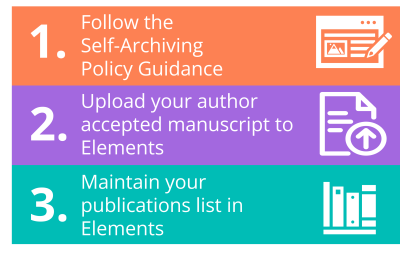
Upload your accepted manuscript to the University repository, Apollo, via Elements. The Open Access team (based at Cambridge University Library) will be able to provide guidance on complying with the relevant publisher, journal, and funder open access requirements and will advise on the payment of any APCs. They will also deposit your paper in the University's institutional repository, Apollo, (or one that your funder specifies) and will give you a DOI for it.
Where can I find out more about open access publishing in Cambridge?
The University's Open Research: Publications page provides further guidance on making your papers open access. You can also contact the Chemistry Librarian for further information.
The University has an Open Access Publications Policy Framework, which highlights how the University supports researchers with open access. You can find the policy framework, and a summary on the Open Research website here: https://www.openresearch.cam.ac.uk/cambridge/policies-frameworks/oa-publications-policy-framework
Open Research at the University
The Open Research website defines open research as "creating, conducting and sharing your research as openly as possible." It further clarifies that "Open research is more than just sharing final papers. It’s about sharing the full journey – your data, methods and tools – so others can understand and build on your work. It means rethinking how you plan, do and share research."
The University of Cambridge Open Research Position Statement summarises the University’s approach to Open Research. It sets out key principles for the conduct and support of Open Research at the University. The Statement can be found here: https://www.openresearch.cam.ac.uk/cambridge/policies-frameworks/open-research-position-statement
The University of Cambridge is a signatory of DORA (San Francisco Declaration on Research Assessment), a set of recommendations agreed in 2012 that seek to ensure that the quality and impact of research outputs are "measured accurately and evaluated wisely".
What is a Self-Archiving Policy?
Self-archiving means providing a version of your manuscript in an open access repository, for non-commercial use, usually with a CC-BY licence. The University of Cambridge Self-Archiving Policy (SAP) came into effect from 1 April 2023. The Open Research website provides guidance about the policy and details what you need to do when you're accepted for publication. It also provides information on what to do if you choose to opt out. You can read the full SAP along with a summary here: https://www.openresearch.cam.ac.uk/cambridge/policies-frameworks/self-archiving-policy
Cambridge is one of a growing number of universities bringing in a SAP or Rights Retention policy. Prof Stephen J. Eglen, from the Department of Applied Mathematics and Theoretical Physics at Cambridge, provides a map and list of UK institutional rights retention policies.
What is Plan S?
Plan S is a manifesto for full and immediate Open Access set out by a coalition of research funders, including UKRI and the Wellcome Trust. Plan S has one goal (full and immediate Open Access to publicly funded research outputs) and ten supporting principles. The key principle is: "After 1 January 2020 scientific publications on the results from research funded by public grants provided by national and European research councils and funding bodies, must be published in compliant Open Access Journals or on compliant Open Access Platforms."
You can use the Journal Checker Tool provided by cOAlition S for authors to support them in finding Plan S compliant "routes" through which to publish their articles. The tool allows an author to enter the name of a funder, an institution and the journal to which they plan to submit an article, and checks if this combination of funder, institution and journal offers any route to compliance with Plan S.
